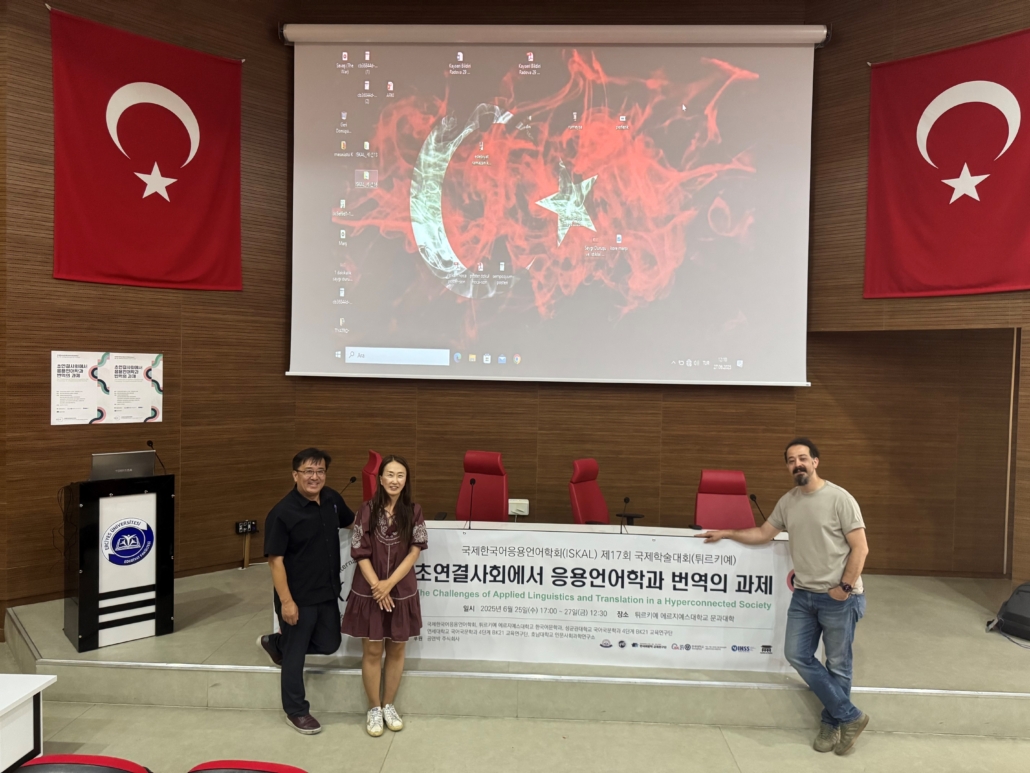
Richmond Academics Present at Conference in Türkiye
Author: Richmond American University London
In June, Dr Moun Shin, Adjunct Assistant Professor of Korean at Richmond, participated in the 17th International Conference of the International Society of Korean Applied Linguistics (ISKAL), hosted by Erciyes University in Kayseri, Türkiye.
At this leading global forum for applied linguistics and Korean language education, she presented her research entitled Creating AI Agents for Korean Language Learning: A Conversational Framework for UK University Implementation. The presentation introduced an innovative approach to enhancing Korean language learning through AI-powered conversational agents, tailored specifically for learners in UK university contexts.
Her work explores how curriculum-aligned AI agents can be used to simulate meaningful dialogues, provide personalised feedback, and expand opportunities for spoken interaction beyond the classroom—addressing key pedagogical challenges such as limited practice time and learner confidence.
The session, part of a broader conversation on digital learning tools in Korean education, generated significant interest from fellow researchers and educators seeking to integrate emerging technologies into language instruction.
Ahead of the conference, Dr Shin also engaged with international scholars working at the intersection of language teaching, AI, and education policy, contributing to discussions about the ethical and practical implications of AI in applied linguistics.
Reflecting on her participation, Dr Shin noted, “This research aligns with Richmond’s mission to promote innovation, global engagement, and intercultural understanding. I’m excited to be part of shaping the next chapter in Korean language education.”
The project continues to develop through further academic collaborations and upcoming pilot programs. Richmond American University London is proud to support research that advances both educational technology and Korean language education.
Moun Shin extends her appreciation to the Research Development Committee and Associate Dean of Research, Dr Theano Lianidou, for their ongoing support.