
“Questions of money, its possession and its lack, underpin her fiction.”
Written by Dr. Catherine Dille, Associate Professor of International History.
December 2025 marked the 250th anniversary of the birth of one of Britain’s most admired authors, the novelist Jane Austen (1775-1817), with a season of BBC adaptations of her novels, academic conferences, new editions of the books and a full calendar of costumed Regency balls – one held at the Bank of England, no less. While this was a signal year for Austen enthusiasts, her image had already achieved national prominence on the ten-pound notes bearing her portrait which have circulated in British wallets and cash tills since 2017.
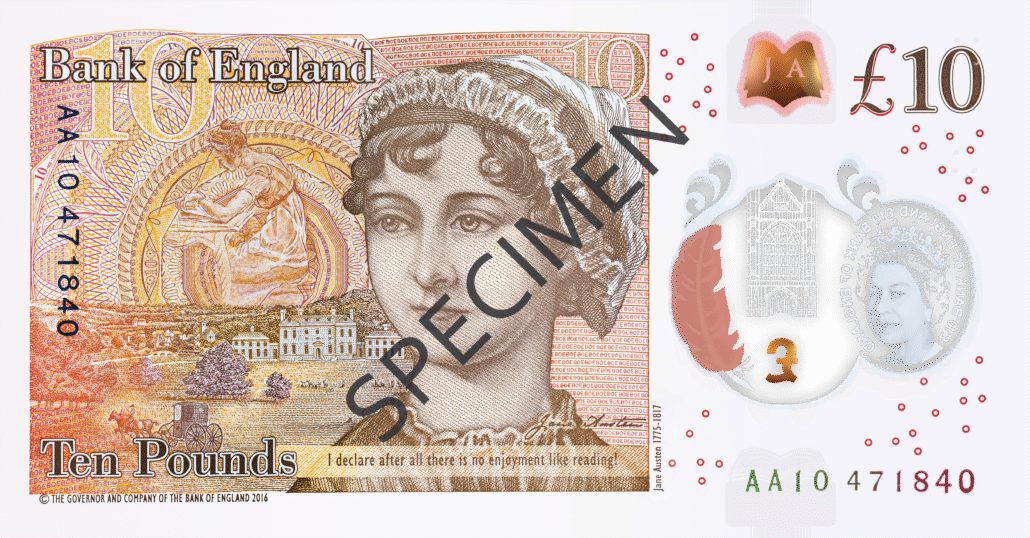
Other writers had previously been honoured on the currency: Shakespeare (£20) was the first non-royal to feature on British banknotes in the 1970s, and Dickens (£10) had his turn in the 90s. But Austen’s appearance, not a foregone conclusion, was the result of a popular campaign initiated by the feminist author Caroline Criado-Perez when the Bank of England announced in 2013 that the £5 featuring the prison reformer Elizabeth Fry would be phased out and replaced with Winston Churchill. The departure of Fry meant that no woman would be represented on British legal tender apart from the Queen. The only other woman previously to have been commemorated was Florence Nightingale (£10) from the mid 1970s to 90s. Over 23,000 people responded to Criado-Perez’s appeal on social media to petition for Austen’s selection, and in 2013 Mark Carney, as incoming Governor of the Bank of England, announced that Austen would appear on the new £10 note. Supporters of the Austen campaign celebrated by pledging to donate their first ‘Austenner’ to women’s shelters and charities across the country.
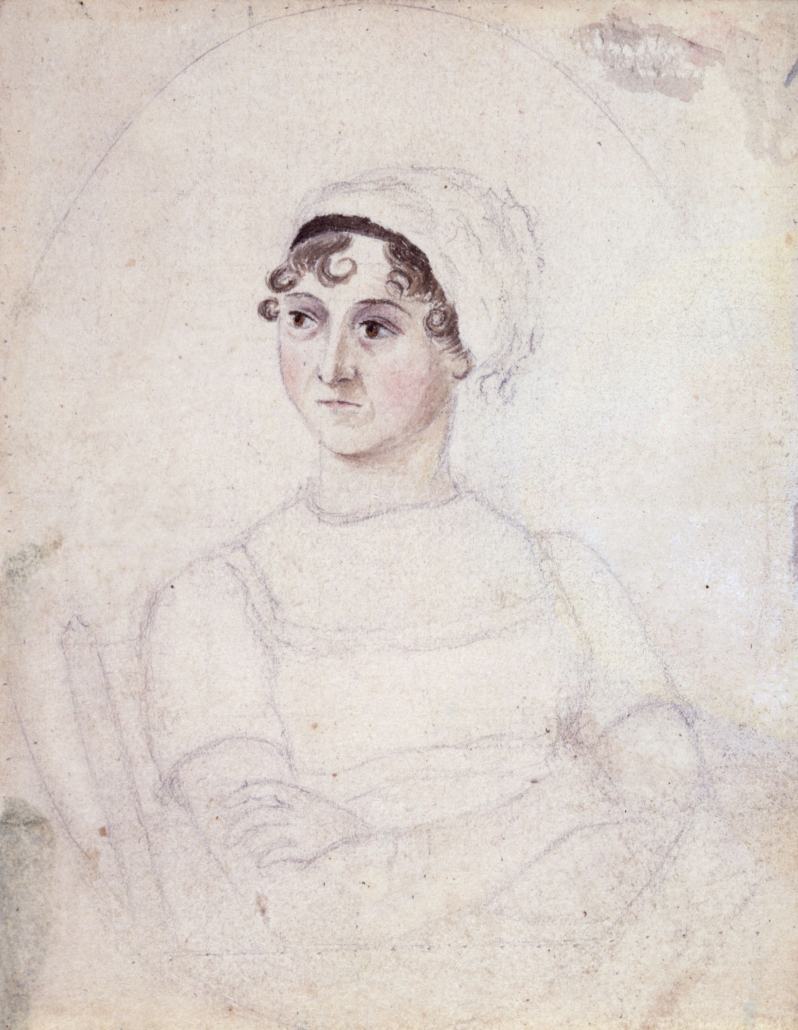
The sentimentalised portrait of Austen that features on the £10 note (Fig 1) was commissioned by the Austen family in 1870 and owes more to Victorian conceptions of ‘dear Aunt Jane’ than fidelity to her sister Cassandra’s original sketch (Fig 2), now in the National Portrait Gallery, on which it is based.
Beyond her status as a literary icon, Austen was an inspired choice to feature on the note: questions of money, its possession and its lack, underpin her fiction. Austen understood and represented the economic realities of women compelled to navigate a society in which marriage was often the only reliable safeguard against penury. ’Elinor, for shame! … money can only give happiness where there is nothing else to give it’, declares Marianne in Austen’s 1811 novel Sense and Sensibility, but her clear-eyed sister Elinor knows that wealth has a great deal to do with happiness, and that she and Edward are not so in love that they can afford to marry and live on his small income as a country clergyman.
Austen makes financial calculations explicit in her works. The plots of her early novels all revolve around who has, and who will inherit, what. As literary scholar Edward Copeland has observed, Austen’s contemporaries were ‘actively interested in knowing the incomes of their neighbours’, which were generally public information. Money was not a taboo subject for discussion in Regency England; everyone knew who could afford to keep a carriage, who rented and who owned their estate outright – as well as who had made their fortune ‘in trade’. The 20th-century poet W.H. Auden may have self-mockingly confessed himself ‘shocked’ at Austen’s pragmatic material realism, in revealing ‘so frankly and with such sobriety / The economic basis of society’, but she inscribed in her fiction hard economic truths that were well understood by her nineteenth-century readers.
“financial miscalculation could have lifelong consequences.”
Fortunes rose and fell in the volatile period around the Napoleonic Wars; Austen’s favourite brother Henry, with whom she often stayed while in London, had joined with others to found a private bank which failed in 1816. As a working writer, Austen appreciated the modest measure of independence that earning her own money conferred, recording a calculation of her ‘Profits of my Novels’, in a manuscript now in the Morgan Library, New York. Austen, her unmarried sister Cassandra and widowed mother, managed their limited income carefully and partly relied on the generosity of her brothers. The choices women made were constrained by the narrow economic options available to them, and financial miscalculation could have lifelong consequences.
Attentive readers of Austen’s novels have long recognised that, with her keen understanding of the impacts and implications of financial matters for women’s lives and happiness, Jane Austen was always on the money.
Specialising in social and cultural history, Dr. Catherine Dille’s research on education, culture and family history in the early modern period informs her teaching on Richmond’s BA International History. She has also recently written on ‘The Sociable Jane Austen’ for Digitens.



Leave a Reply
Want to join the discussion?Feel free to contribute!